Stories
How MƒA Master Teacher Andrew Rodriguez gained the confidence and support to overhaul his math class setup and curriculum.
Several years ago, Andrew Rodriguez was searching for ways to spark engagement in his 7th-grade math classes. Seeking inspiration, he joined an MƒA book club to discuss Building Thinking Classrooms in Mathematics (Grades K-12) by Dr. Peter Liljedahl. While he expected thought-provoking discussions with his colleagues, Rodriguez could not have predicted how profoundly the experience would transform his teaching practice.
“The whole mindset is that as a teacher, I’m a facilitator and a guide, but I’m not going to give you everything,” Rodriguez says. “I’m going to give you just as much as you need, so that you can do the thinking, the exploring and the learning.”
With its focus on decentering the teacher and placing the onus of learning on the students, the idea of building a “thinking classroom” completely reshaped Rodriguez’s approach to math education. The book club provided the ideal outlet for exploring this model and brainstorming practical steps he could take to implement it.
Image
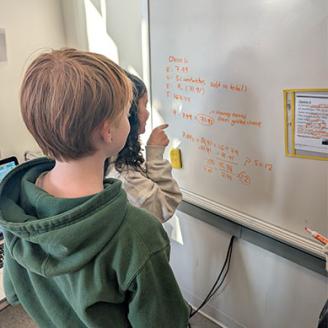
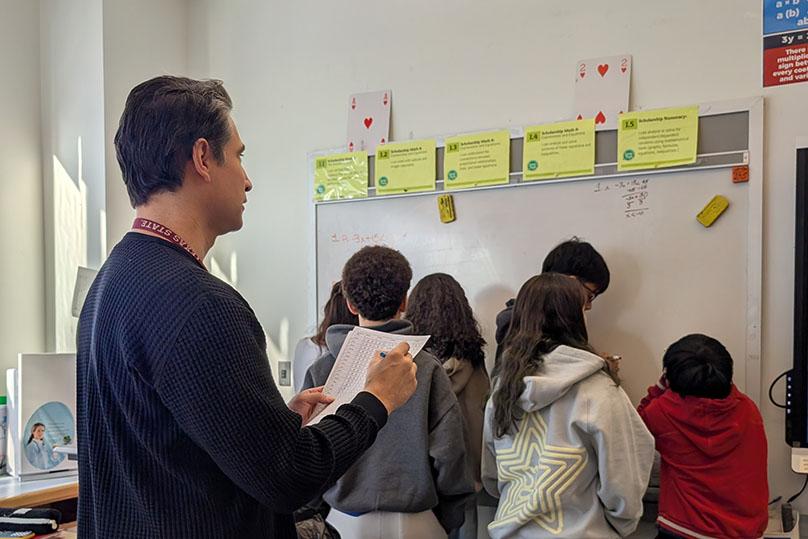
Rodriguez first focused on shaking up his classroom setup at Hunter’s Point Community Middle School in Long Island City, where he has taught since 2016. Moving away from teaching from the board at the front of the room, he began using vertical, non-permanent writing surfaces and assigning students to work in randomized groups. “The goal is not to always be looking at just the front board,” Rodriguez explains. “You want everyone’s work to be highlighted in some way.”
Rodriguez concentrated on getting the students to their boards and collaborating as soon as possible. As a result, they spent more time on task and he had more opportunities to observe their work and provide feedback. “The more things you can do to get kids up, moving, talking, thinking, the better,” he says.
The “thinking classroom” model also inspired Rodriguez to reshape the flow of his curriculum to better serve his students. He moved the statistics unit to the beginning of the year, allowing them time to acclimate before tackling more complex and unfamiliar concepts. “It takes a little bit of time for students to understand the expectations and the rules, and for them to be a part of the process of creating the classroom norms,” Rodriguez says. “We don’t need to rush into this really high-stakes content at the very beginning of the year.”
Similarly, Rodriguez decided to move a unit on the number system later in the school year, because it marked the first time students would be working with anything other than positive numbers. This change “helped students work through rich and rigorous situations while still involving the types of numbers they're familiar with from previous grades,” he explains. “Then toward the end of the year, we can talk about positive and negative numbers and how they interact.”
Image
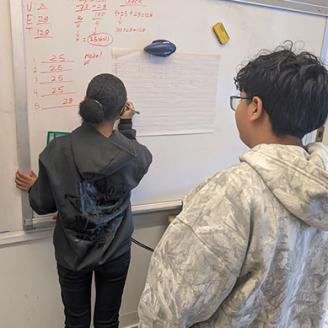
Along the way, Rodriguez shared his efforts with his co-teachers at Hunter’s Point. “Once they saw the conversations and the quality of work that was on the boards compared to their previous experiences with just having kids do worksheets or talking with teammates at their desks, they were really bought in,” he says of his colleagues.
Though transitioning to a different mode of classroom required some troubleshooting, Rodriguez saw the impact of the changes he made on his students. “We gave ownership of the learning to the students and they ran with it,” he says. “That mindset has really elevated their work.”
Rodriguez also saw improvements as a result of the curriculum changes, “Now when they see our exams at the end of the unit or a state exam at the end of the year, they’re confident they have the skills, and have built good habits as a math student,” he says.
As someone dedicated to continuous learning, Rodriguez appreciates the breadth of professional development opportunities available through MƒA. He signs up for more than the required number of sessions each year, diving into topics ranging from mycology to solving Rubik’s Cubes to giving more effective feedback. He’s also served as a facilitator, including a recent session on how teachers can incorporate fine arts concepts into building educational material and a planned workshop on fermentation.
“MƒA is all about keeping teachers engaged in the classroom and inspiring them,” Rodriguez says. “Everyone wants to bring their best selves and share their experiences, their triumphs, their failures. It’s an environment to thrive, to test things out, and to not feel scared.”