Stories
How MƒA Master Teacher Carolina Castro figured out how to teach hydroponics and embed sustainability in her classroom.
For Carolina Castro, a veteran teacher of earth science at the Comprehensive Model School Project, a 6-12 school in the Bronx, the journey to a new way of teaching sustainability started with a single MƒA workshop in hydroponics. Though she was amazed by the scale and quality of the hydroponics lab where the workshop was held, she thought building something similar at her own school would be impossible.
Then the pandemic arrived, and the school received emergency relief funding. Tasked with finding ways to spend that money, Castro decided to create a “manageable, functional hydroponics lab that could live in one of our high school classrooms, be used by students every day, and slowly grow over time.”
Image
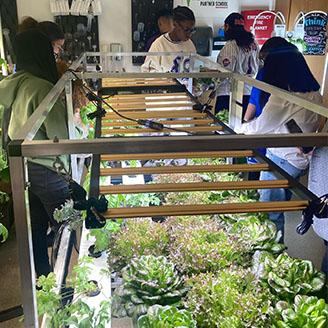
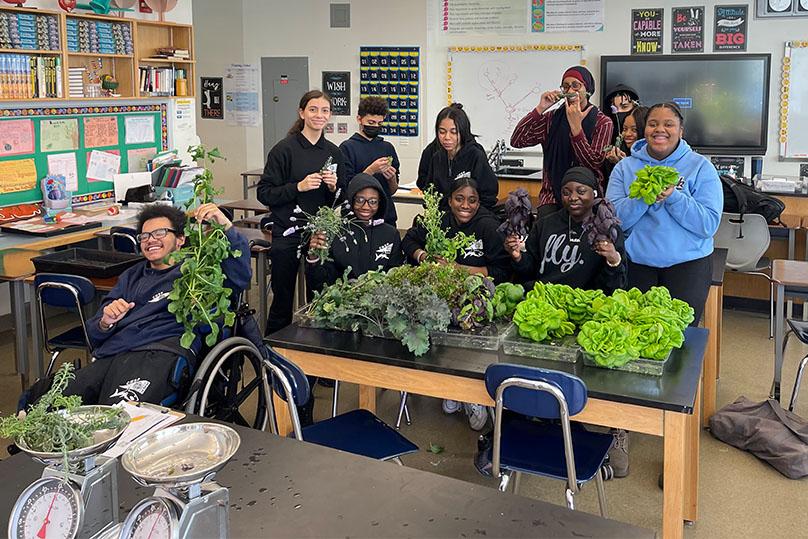
Castro partnered with New York Sun Works to launch the lab, along with a course in hydroponics and sustainability. Given her background in geology, she initially thought that colleagues who taught biology would take over the course, but it soon became clear that it was her project. “Everyone who knew me thought this was the most hilarious thing,” she says. “They're like, you actually do have a pet rock.”
From the beginning, Castro saw the hydroponics lab as part of a larger effort to help embed sustainability into the school’s culture. She and her students tackled multiple challenges along the way, from floods and power issues to escaped worms and aphid outbreaks. Castro was open with her students about her lack of experience, and they welcomed the chance to figure things out together. “We learned through trial and error, asking questions, and not being afraid to fail,” she says.
Over three years in the lab, Castro and her students planted and harvested spinach, kale, basil, arugula, peppers, cucumbers and cucamelons. Efforts such as strawberries and flowers were less successful, but they kept trying to learn what worked well and what didn’t. In addition to enjoying (most of) the fruits of their labors — what they didn’t eat went to other members of the school community, or a local shelter — Castro’s students took ownership of the lab in a way she found very gratifying.
“They monitored plant growth, collected data, wrote grants, and presented their work to local leaders,” she says. “The lab became more than a project — it became a place of community, connection and empowerment.”
Image
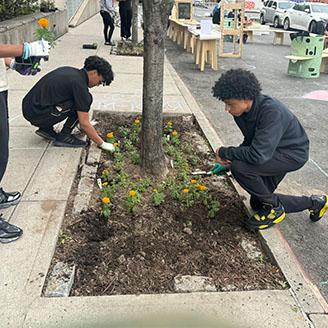
In accordance with the course’s focus on sustainability, her students also worked with the sanitation department to care for the trees planted on the streets outside their school. In outings around the neighborhood, they noted the lack of grocery stores with fresh produce, and talked about how what they’re learning in the classroom could help. “It became this kind of a-ha moment for them, where they realized there can be alternative ways to deal with these issues that we're facing,” Castro says.
Eager to learn more, Castro took additional hydroponics workshops at MƒA, along with sessions on building Green Teams and Earth Day programs. “Every one of these gave me something new — ideas to test, tools to improve, and opportunities to network with educators and stakeholders in education and climate science doing meaningful work,” she says.
In 2023, thanks to an Impact Grant from MƒA, Castro got the opportunity to travel to Vienna, Austria for Geoscience Information for Teachers (GIFT), a program offered by the European Geoscience Union for primary to high school science teachers. Her students helped her prepare materials for a presentation she delivered on the needs and difficulties of using hydroponics in an urban classroom.
“I made the connection between hydroponics and all the different types of earth science that are related,” Castro says. “I spoke about how it’s related to our community, why it matters, and how it can be done in any space, including ours.” One of only three teachers in the program from the United States, she enjoyed connecting with fellow educators and scientists from Spain, Portugal, Italy and other countries, and remains in contact with some of them.
Image
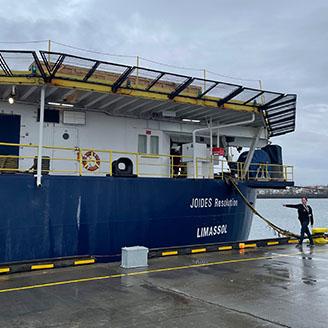
Castro ventured out of her comfort zone again in the fall of 2024, when she went on a two-week expedition from Reykjavik, Iceland, to Amsterdam aboard the ocean-drilling ship JOIDES Resolution. Closer to home, she took on an even more intimidating challenge when she recounted her journey with hydroponics at the 13th annual MT² Master Teachers on Teaching conference.
“That was one of the hardest things I’ve ever done,” Castro says. “I’m glad that there are people in MƒA that see that you have something to share. And if you’re a little bit anxious about it, they’re helping you along the way.”
MT² Master Teachers on Teaching
Amid aphid invasions and wandering worms, Carolina Castro—a proud ‘rock dork’—shars her journey from geologist to unexpected advocate for environmental stewardship, guiding her Bronx students to use their hydroponics lab to make a lasting impact.