
Workshop Spotlight
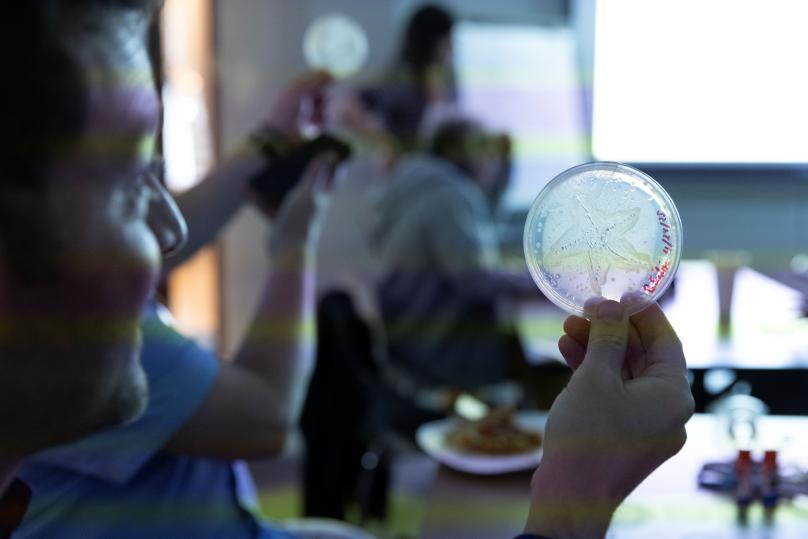
There are countless ways to bring art into the science classroom—but what if students could “paint” with living organisms?
In the two-session mini-course Picassos in the Laboratory: Creating Agar Art in the Classroom, MƒA Master Teachers Gilbert Papagayo and Brittany Klimowicz invited teachers to explore bacterial transformation, protein structure, and recombinant DNA through an unexpected medium: microbial agar art. The idea for the course began, fittingly, with a mistake.
Image
While teaching a bacterial transformation lab using a plasmid encoding green fluorescent protein (GFP), Gilbert inadvertently plated already-transformed bacteria on the starter plates students were meant to use. When every plate produced glowing colonies, students were unable to collect meaningful data. Faced with the mishap, he pivoted—inviting students to “draw” with the transformed bacteria instead. The result? Engagement soared.
“Both disciplines require a lot of creativity,” Gilbert reflected. “Science requires creativity in designing experiments, and art requires creativity to develop and articulate a coherent vision.”
In the first session, MƒA teachers examined nonpathogenic microbes suitable for classroom culture, including Escherichia coli, Micrococcus luteus, and Pseudomonas fluorescens. They studied the structure and function of GFP, exploring how fluorescent proteins serve as biological markers and how their three-dimensional structure enables them to glow. Participants then designed and plated their own agar art using E. coli transformed with fluorescent plasmids.
Image
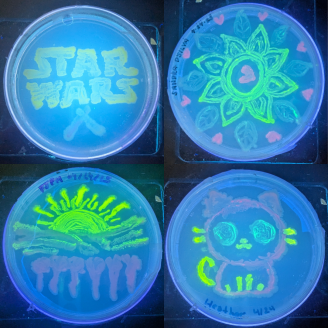
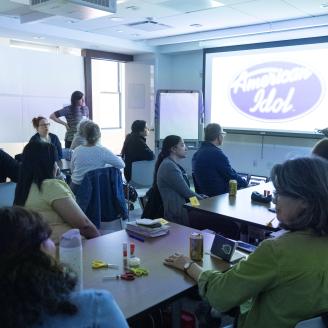
The second session centered on observation and reflection. After allowing the plates to incubate and develop, teachers reconvened to admire their creations under UV light. Using the rubric from the American Society for Microbiology’s annual Agar Art Contest, participants evaluated each piece for scientific understanding, creativity, and clarity of explanation. The judging process itself became an opportunity to consider how scientific communication, aesthetics, and conceptual understanding intertwine.
Because bacterial transformation is widely taught in middle and high school life science classrooms, Gilbert and Brittany designed the mini-course with classroom transfer in mind. Alongside creating agar art, teachers jigsawed lessons on recombinant DNA, constructed paper plasmid models, and explored the history and mechanics of gene cloning.
For Brittany, who was teaching a course on the human microbiome at the time, the workshop offered a new lens on familiar content.
“Since bacterial transformation can be challenging for some students, we wanted to find ways for it to come alive and become more accessible,” she explained. “And it was wonderful to create space with other teachers who wanted to explore microbial art, be creative, and overall, have a fun and informative experience together.”
Promoting creativity, both facilitators emphasized, is central to strong science instruction. Designing experiments, troubleshooting protocols, and interpreting data all require the same generative thinking that fuels artistic creation. Teachers left the course not only with glowing plates and practical lab ideas, but with a renewed appreciation for how beauty and biology can coexist in the same petri dish.
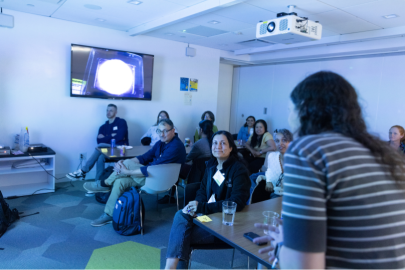
Teachers explore microbial art, enjoy hands-on fun with glowing bacteria, and leave with practical lessons and resources to use in their classrooms.