Workshop Spotlight
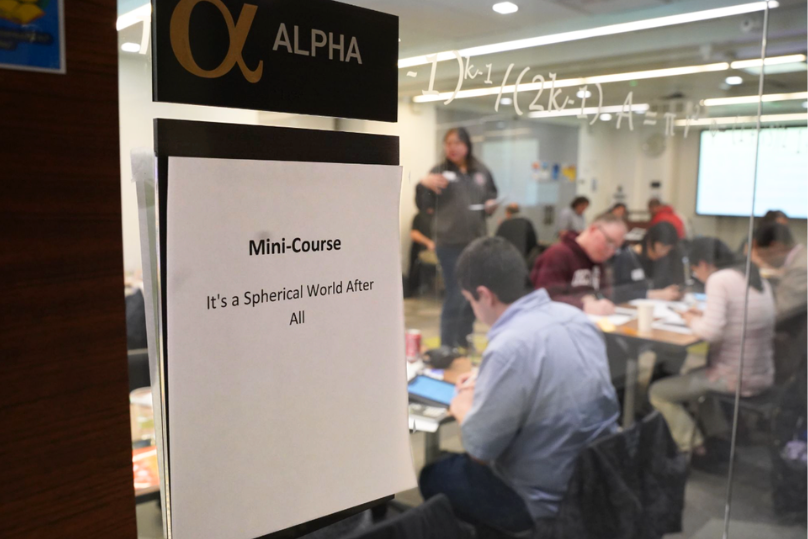
Non-Euclidean geometry fundamentally reshapes how we understand space, with implications that extend from the classroom to Einstein’s theory of relativity.
Image
In the early 1900s, topics like spherical geometry and trigonometry were not only studied in high school but also appeared on Regents exams, where students were expected to reason through complex problems and perform calculations without calculators. Today, despite its continued relevance in fields such as aviation, maritime navigation, astronomy, and GPS, this branch of mathematics is rarely taught at the secondary level.
In the mini-course It’s a Spherical World After All, facilitated by MƒA Master Teachers Michael Archetti and Shari Eng, participants explored spherical mathematics, its relationship to Euclidean geometry, and its historical place in the curriculum. Inspired by his own experience studying non-Euclidean geometry in college, Michael was struck by “the elegance of the formulas and how they relate back to Euclidean geometry,” and together, he and Shari designed the course as an entry point into the core ideas of spherical geometry.
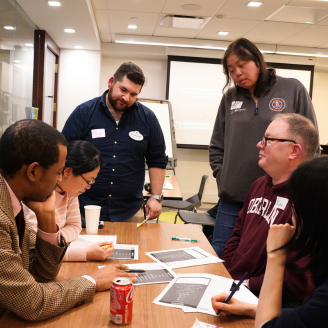
Over three sessions, teachers examined how familiar trigonometric relationships extend to the sphere, beginning with foundational formulas and building toward more complex applications. Participants worked collaboratively through sample problems, including questions from early 1900s Regents exams, using them as a lens to reflect on shifts in mathematical expectations, language, and rigor over time.
Image
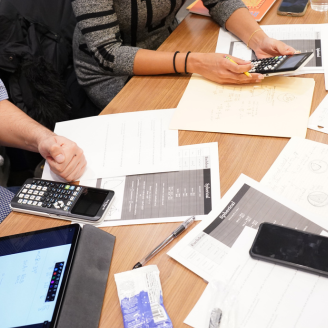
“The participants were given the space to share thoughts not just on the content, but on student expectations in the past versus the present,” Michael noted. “It felt like a community where everyone was involved in the discussion—not only of the math, but of the educational context in which these exams were given.”
As the course progressed, teachers engaged with topics such as Napier’s rules for right spherical triangles, the pentagram, and spherical excess, while also considering how these concepts connect to real-world contexts. From calculating sunrise times using latitude to understanding global navigation, participants explored the continued relevance of spherical mathematics in everyday life.
“Our favorite part of facilitating this course was the interaction with fellow MƒA Master Teachers,” Shari shared. “Participants were genuinely interested in the content and actively engaged throughout all three sessions.”
By revisiting a once-central area of mathematics through both historical and modern lenses, the course invited teachers to step outside the constraints of test-driven instruction and reconnect with the inquiry, beauty, and broader purpose of mathematics—bringing fresh perspective and inspiration back to their classrooms.
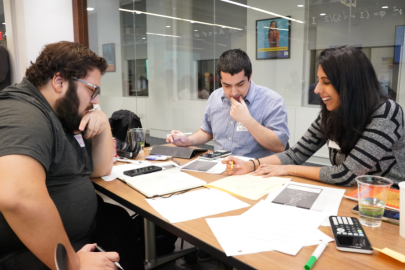
Together, teachers explored non-Euclidean geometry, discussed its impact on today's mathematics curriculum, and considered ways to integrate these concepts into their classrooms.