Workshop Spotlight
Rethinking Access in Math and Computer Science
Last semester, Dr. Colleen Lewis, an Associate Professor of Computer Science at the University of Illinois at Urbana-Champaign and Dr. Darryl Yong, a Professor of Mathematics at Harvey Mudd College, each led a separate MƒA course. While vastly different, both workshops examined how teachers can intentionally design learning experiences—through tools, framing, and beliefs—to make abstract disciplines more accessible, inclusive, and meaningful for students. The other common denominator? Both Lewis and Yong are members of the MƒA Board of Directors.
Image
The MƒA Board of Directors are global leaders in mathematics, science, education, and business. They are dedicated to advocating for the MƒA model and sustaining excellence in mathematics and science education. Yong and Lewis were first introduced to MƒA through MƒA LA. Yong supported founding the organization in 2007 and Lewis worked with teachers in the program since it expanded to support computer science teachers in 2018. Yong has facilitated MƒA courses for many years while this was Lewis’ first chance to collaborate with the MƒA community at this level.
“By supporting teachers, we can benefit a whole generation of students,” added Lewis. “The MƒA model creates opportunities for collaboration and peer learning, and it respects teachers' existing competence and commitment to their students.”
“It's so fun to be deeply engaged with a group of highly skilled, curious, rigorous thinkers,” said Yong. “Over the years, MƒA teachers have pushed me to articulate my ideas more clearly. My hope is I always do the same for them.”
Teaching With Physical Objects: Matching the Physicality to Pedagogical Goals with Colleen Lewis
Image
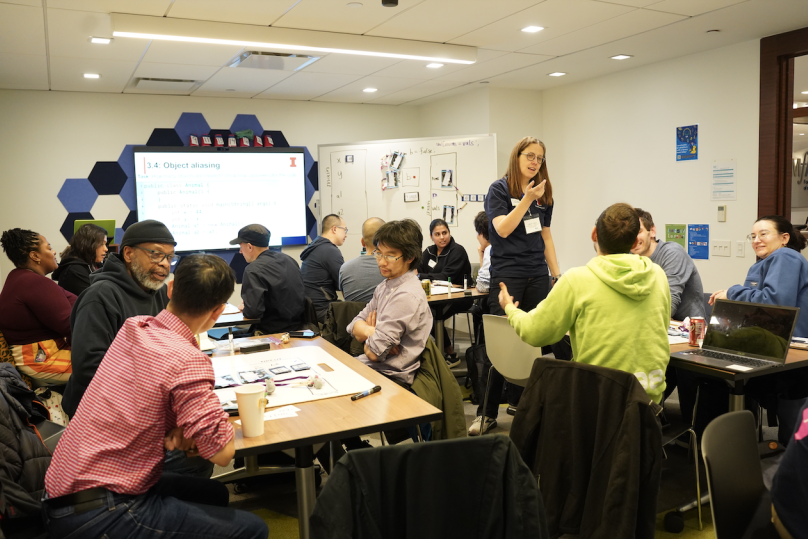
While working with math teachers, Lewis realized that computer science teachers can learn a great deal from math teaching. In particular, there is a hidden opportunity to ground abstract representations, pictures, and diagrams in teachers’ and students’ understandings of physical objects. Lewis eventually partnered with Robb Lindgren, an expert in embodied cognition, to explore how educators can interrogate the ways physical representations support student learning. When leading this MƒA single session workshop, Lewis’ led teachers in analyzing and critiquing examples and counterexamples of how physical objects are used in computer science classrooms.
“The two hours were jam-packed with engagement and interaction. Since I was just meeting everyone and there were no preexisting close relationships, I expected it would be harder to build trust, community, and meaningful conversation,” said Lewis. “I was wrong! The discussion was dynamic, with participants thoughtfully monitoring their airtime so that everyone contributed multiple times to the whole-group conversation.”
Teachers identified the varied pedagogical uses of physical objects for teaching computer science and explored how those objects can make abstract concepts concrete, constrain interpretation of code, facilitate collaboration, support pattern recognition, activate prior knowledge, draw attention to important details, and help manage complexity.
Mathematics Philosophies: Platonic or Socially Constructed? with Darryl Yong
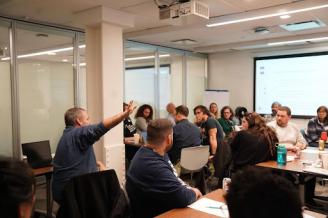
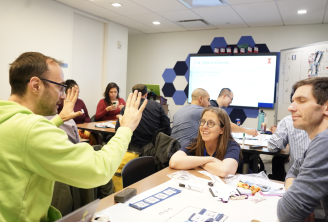
Like many of us, Yong has worried about the difficulty of engaging people in meaningful dialogue across differences in today’s world. On the face of it, this doesn't seem like a problem that relates to mathematics. Yet he realized that while teaching math, it’s just as important to impart content to students as it is to help them think critically about what kind of influence they can have on the world through STEM. In this mini-course, Yong guided teachers to explore multiple philosophies on the nature of mathematics and examined how dominant Platonic views (math existing independent of human activity) can often limit access and hinder learning.
Image
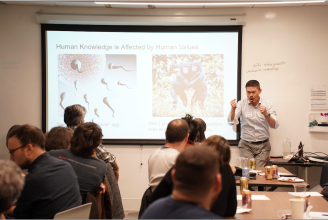
“My initial concerns led me to learn more about epistemic agency--the ability to control one's own knowledge-gathering, belief-forming, and knowledge-evaluating processes. How could I support students so that they could be more intellectually humble and curious while still being rigorous in their search for meaning in their own lives?” said Yong. “By helping them develop more mathematical epistemic agency, we can help to encourage more students to see themselves in mathematics and support agency for things other than mathematics.”
During one workshop, teachers analyzed resources, reflected on classroom implications, and developed ways to make math classes more inclusive. They left with a more nuanced understanding about various mathematics philosophies and how subtle messages can affect the way that students experience classrooms.
Scientists and Musicians Unite!
Dr. Stephon Alexander is a theoretical and computational physicist, author, and Jazz musician. He is also a member of the MƒA Board of Directors.
Last year, Alexander led an MƒA Interest Group on the intersection of music and science. Teachers shared their own love of music, brainstormed collaboration opportunities, and learned about curricular and after-school programs with Sound + Science, an organization that empowers young people to explore STEM through their passion for music.
The year prior, at the 16th Annual Fall ƒunction, Alexander shared his presentation “The Jazz of Spheres” using the language of music to describe the cosmic and mathematical mysteries of the big bang. He discussed how his high school teacher and mentors inspired his journey between music, math and physics, and ended with an Improvisational Jazz Saxophone rendition.