Workshop Spotlight
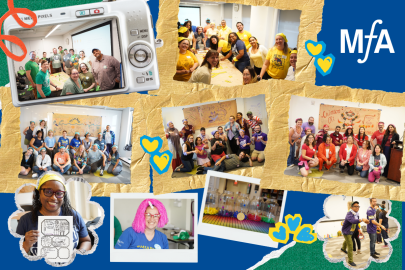
What happens when MƒA teachers come together for three days over the summer with the intention to think deeply, play freely, and reimagine what’s possible in their classrooms?
Image
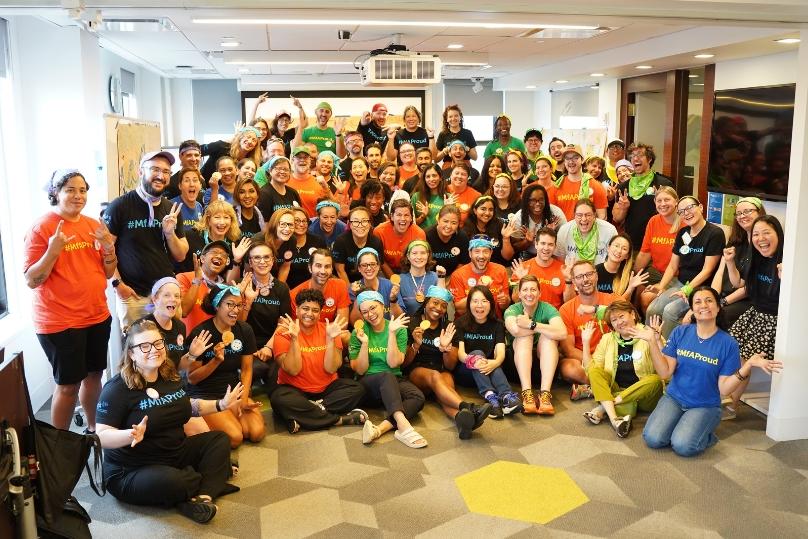
Now in its ninth year, the MƒA Summer Think is a teacher-designed, teacher-focused, and teacher-led conference that gives educators the time and space to explore meaningful ideas alongside their peers. This year’s theme, Vivid Minds, Vibrant Classrooms: Thinking, Playing, and Learning in Color, invited the MƒA community to embrace play, productive struggle, and collective problem-solving while reflecting on how creativity, curiosity, adaptability, and joy can transform learning.
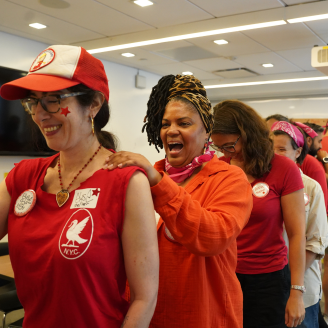
And for the first time, Summer Think added a friendly competition to the mix called the Color Olympics. Divided into teams of red, blue, green, yellow, and purple, teachers completed missions and challenges to earn points for their teams. There were trivia and math games, scavenger hunts, cornhole, relay races, and paper airplanes. The Color Olympics brought a summer-camp energy to the conference, creating new opportunities for teachers to connect with colleagues outside their usual subject matter and grade levels. For MƒA Master Teacher AnnaMarie Hauser, who attended her eighth Summer Think, this was one of the main highlights.
“I really enjoyed the competition & community time this year. I am typically someone who does not enjoy ice breakers and team-building activities, but I loved how the games had something for everyone,” said AnnaMarie. “Being a part of Team Red, aka Crimson Chi, and getting to interact with other MƒA teachers, some that I already knew and some that were new to me, was a really positive experience.”
The new competition was fun, but it was also purposeful. By mixing teachers across their content and interests, the Color Olympics encouraged collaboration in unexpected ways. Reflecting on her fourth Summer Think, MƒA Master Teacher Kiersten Franz said, “We were really mixed up in disciplines, and the game aspect of the Olympics also motivated us to collaborate with each other in new ways.”
That spirit carried throughout the conference, where playing, experimenting, debating, creating, and learning were intentionally intertwined.
Going Deep
Each MƒA teacher selected a three-day workshop or “Deep Dive” to participate in, allowing them to spend sustained time exploring a topic while considering how it might reshape their teaching.
In The Art & Science of Resilience, Dr. Beka Stecky and MƒA Master Teachers Jamie Kubiak and Anoopa Singh invited teachers to turn inward, drawing on neuroscience and metacognition to explore emotional resilience. Teachers examined their own emotional landscapes, learned strategies for interrupting patterns of dysregulation, and shared stories and experiences. In Becoming Expert Learners Through Research, Reason, and Routines, Dr. Rhonda Bondie guided teachers through research on motivation, cognition, neuroscience, and culturally relevant education. Teachers considered what deep learning requires and developed classroom routines designed to help students become more confident, capable, and independent learners.
Image
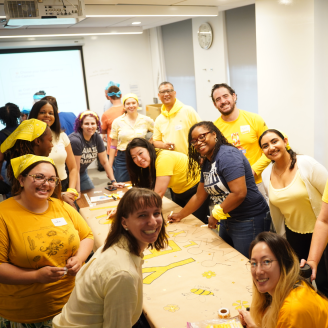
For AnnaMarie, the Deep Dives provided a new lens for thinking about classroom culture.
“Our sessions together helped me reflect on what a vibrant classroom looks and feels like, and something I will be more intentional about this school year is using math routines to support student discourse.”
Kiersten came away with a similar vision. “To me, a vibrant classroom really looks like one in which all the students feel agency and belonging in the community that we created, and therefore has a variety of voices and ideas that are heard and shared.”
Her work with Dr. Bondie also led her to develop three routines she plans to use in her classroom, including one she calls “Collect, Review, Revise.” The routine asks students to revisit and improve study guides they have already created, turning revision into an opportunity for synthesis, interleaving, and student agency.
Elsewhere, Talk Less, Smile More: Debate and Discussion in the STEM Classroom, led by MƒA Master Teachers Matt Baker and Devin Sprague, focused on a deceptively simple question: What happens when teachers talk less, and students talk more?
Teachers practiced structures to increase student-to-student conversation and to make mathematical and scientific reasoning visible. Even playful questions became opportunities to practice building arguments, listening carefully, and defending ideas.
For MƒA Master Teacher Mike Fernandez, his first Summer Think was a powerful reminder that rigor and joy can coexist.
Image
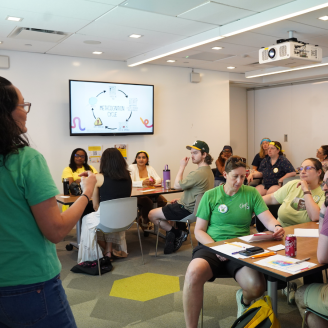
“The exuberance I experienced when we debated scientific concepts using claims and warrants inspired me to make my classroom more vibrant by integrating these routines into my teaching practice.”
Teachers in Thinking in Color: Observation, Perception, and Inquiry Across Disciplines With RockEDU explored how color can become a gateway to scientific inquiry, creativity, perception, and systems thinking. Across chemistry, biology, physics, mathematics, history, and art, they investigated pigments, prisms, fluorescence, dyes, fast fashion, and even protein structure, considering how observation shapes the questions we ask about the world.
And in Welcome to the STEM Playground!, Kara Imm, Ph.D., and MƒA Master Teacher Daniel Salamon challenged the idea that play and rigorous learning are opposites. Teachers explored the features of playful learning and considered how curiosity, openness, creativity, and embodiment can create deeper connections to mathematics and science.
For MƒA Master Teacher Bridget Mahoney, a Summer Think planning committee member, the experience brought her back to the reason she loves teaching STEM.
“The biggest takeaway from this year’s Summer Think was keeping the classroom playful. I got to participate in Kara Imm’s STEM Playground, and I remembered exactly what I love about being a STEM teacher and how to infuse those curiosities into what I do with my students.”
Making Room to Play
If the Deep Dives gave teachers time to go deep, the “Splash Sessions” pushed them to follow their curiosity wherever it led in short, exploratory sessions.
Image
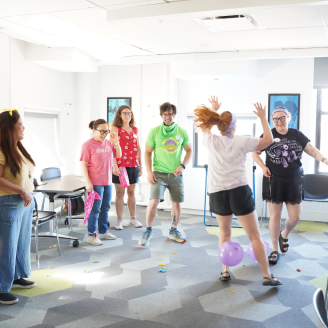
Teachers could make abstract acrylic paintings while exploring chemistry, color theory, viscosity, and fluid dynamics in Chromatic Joy. They could explore identity and visual storytelling through photography and typography in Create Your Portrait, One Letter at a Time. They could turn mathematics into a game in Damath: Think It, Play It, Have Fun!, creating their own classroom-ready versions of the Filipino checkers-style math game.
Other sessions took teachers outside, into art, or into unexpected corners of STEM.
Teachers explored logic puzzles in Beyond Sudoku and KenKen, investigated environmental data in Postcards from Nature, created miniature ecosystems in Mini Ecosystems, Maximum Joy, and used paper crafts to make abstract scientific concepts tangible in From Craft to Concept.
In Framing the Story: The Geometry of Comic Books, Mike explored the mathematics behind visual storytelling, using the Rule of Thirds, Fibonacci sequence, and Golden Ratio to create artwork and consider how students might use comics to communicate complex mathematical and scientific ideas.
Image
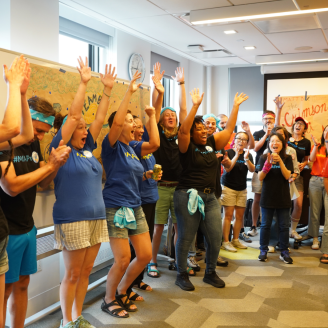
In We Can Still Use Crayons?, teachers explored ways to bring comics, storybooks, art, and other media into advanced STEM courses, reclaiming some of the creativity that can get lost as content becomes more technical. And in Vibe Coding: Build Your Own EdTech!, teachers discovered that they could create functional software simply by describing what they wanted in plain English and collaborating with AI tools. Within an hour, teachers with little or no programming experience could build something tangible and share it with their peers.
The sessions were wildly different, but they shared a common purpose of allowing teachers to be learners again. As AnnaMarie put it, this year's Splash Sessions left her feeling curious.
“All three sessions I participated in encouraged me to be creative and be curious about mathematical ideas. I want my students to explore math, not just because it will be on the Regents, but because it is a beautiful way of thinking about the world, and I want them to always be curious.”
A Different Kind of Professional Learning
The freedom to explore is part of what makes Summer Think distinct. Rather than beginning with a list of outcomes teachers must achieve, the conference creates space for educators to ask "What if?"
Image
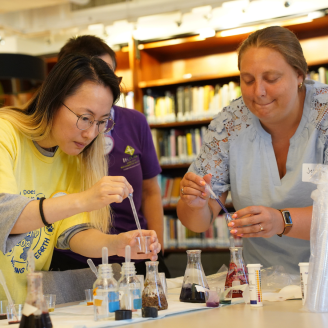
Bridget described it as “the best way to unwind at the end of the school year and to channel all that energy and excitement into something fun. Summer Think is the kind of PD that teachers dream of,” she said. “It takes away the parameters and lets teachers explore.”
That space matters. Teachers arrived at Summer Think carrying the weight of another school year but were given time to pause before immediately turning toward the next one.
For Kiersten, being given that time is crucial. “Having the time and space to think about our vision of education is freeing and exciting.”
It is also a chance to reconnect with the larger MƒA community. Teachers who might rarely cross paths during the school year found themselves collaborating over games, comparing ideas during workshops, making art together, and sharing meals. They’re reminded that learning is supposed to be fun, something that can be easy to lose sight of during a busy school year.
Bringing Joy Back to the Classroom
By the final day, teachers had a chance to slow down and reflect on what they would carry forward. Their answers reflected a renewed sense of possibility.
Image
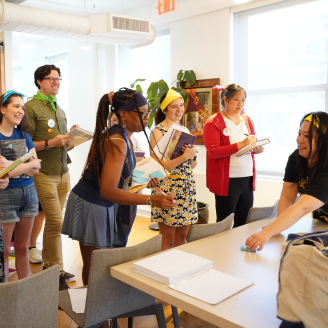
AnnaMarie will bring new routines and the Thing Explainer challenge to her students. Kiersten will implement routines that give students more agency and opportunities to revise and synthesize their thinking. Mike will create more space for student discussion and debate. Bridget will bring more play, curiosity, and student-generated questions into her STEM classroom.
Their takeaways may look different, but they share the common thread that classrooms begin with opportunities to learn. For Mike, the experience can be summed up in one word… Joy.
“From start to finish, the Summer Think recharged and re-energized me. Experiencing that sense of play and discovery as a participant made me genuinely excited to bring these new concepts and routines back to my students. More than anything, it was a joyful reminder of the power of learning alongside such inspiring MƒA teachers.”
"Summer Think is the kind of PD that teachers dream of. It takes away the parameters and lets teachers explore.”