Stories
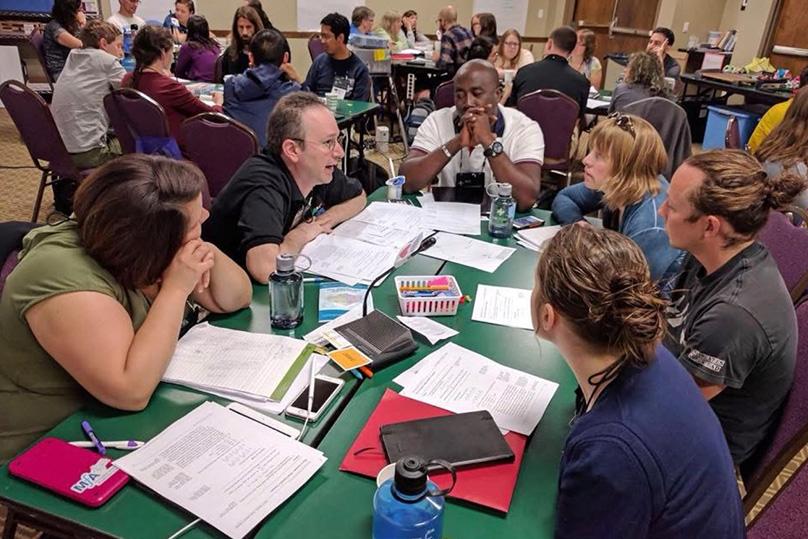
How MƒA Master Teacher Siaka Kone learned to use digital tools to engineer better mathematical conversations in his classroom.
In 2023, with support from MƒA, Siaka Kone attended Desmos Classroom Day at the National Council of Teachers of Mathematics conference in Washington, D.C.
Image
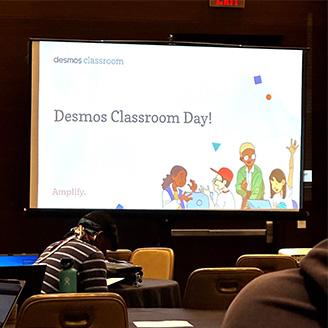
Kone had some prior experience with Desmos, a free browser-based suite of math tools including graphing, scientific, 3D and geometry calculators. Through MƒA, he had taken a workshop on using the Desmos calculators, and experimented with the tools. But this full day of immersive, hands-on engagement with Desmos Classroom marked by far his most in-depth experience so far with the technology.
At the NCTM conference, Kone appreciated how the facilitators employed digital tools to engage students, build their reading comprehension and mathematical literacy, and increase their confidence in discussing math topics. “It became a pivotal learning experience for me, because it showed how technology, when paired with intentional design, can elevate discourse and deepen student understanding,” Kone says.
Kone’s biggest practical takeaway was the facilitation routines, which laid out intentional actions teachers can take to promote student curiosity, reasoning and conversation. He wasted no time putting them into practice in his own classroom at City College Magnet School for the Arts in Inwood, where he has taught since 2010.
As a warmup, Kone saw particular benefits from a routine called Notice and Wonder, which asks students to look at a graph, equation or image and ask themselves what they notice about it and what they are wondering about it. “It gives access to all students, because there’s no right or wrong answer,” Kone says. “Any student can engage with that activity without fear of being wrong.”
With both Notice and Wonder and another warmup routine, Which One Doesn’t Belong, Kone saw how his students were able to build their understanding of mathematical ideas as well as their ability to express them. “Oftentimes when we teach, we tend not to notice that the challenge students are facing is not necessarily the math, but understanding the terms, the vocabulary,” he says. “So giving them the opportunity to develop the language is very important.”
Image
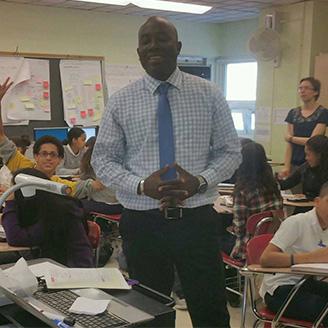
Among the instructional routines he learned through Desmos Classroom Day, Kone also likes using Polygraph, where one student chooses a graph and their partner has to guess which one they chose by asking yes or no questions. “For them to pinpoint the graph, you have to explain the features as precisely as possible,” Kone says. “Again, it allows the student to build that math language.”
Attending Desmos Classroom Day gave Kone an advantage when his district implemented a new curriculum using Illustrative Math, a problem-based K-12 program focused on creating engaging mathematical discussions that used many of the same facilitation routines.
“I had a little more experience, and I felt more comfortable when it came to implementing Illustrative Math,” Kone says.
“I introduced the strategies in department meetings and modeled them during classroom intervisitations.”
Even his colleagues who had been using technology in their classrooms saw a big difference with how the Desmos platform engaged students in mathematical discussions. “As they saw students using clearer language, offering stronger explanations, and participating more consistently, they wanted to know how to try the routines in their own classrooms,” Kone says.
"Technology, when paired with intentional design, can elevate discourse and deepen student understanding."
Kone also credits his experiences in MƒA with helping him gain confidence doing group work in his classroom, which wasn’t the standard in his own educational background. “To me, it was not rigorous, the fact that students help each other,” he says. Early in his MƒA tenure, however, Kone attended a workshop called Making Group Work Work, which he calls a turning point: “All of the fears that I had when it comes to group work were addressed during that workshop and I've gained a lot of comfort doing it. Ever since that day, it's group work by default.”
Seeking to expand his impact, Kone co-facilitated a workshop within the MƒA community on the Desmos facilitation routines he learned. He is also working to develop his own math activities using OpenAI’s Codex, with the goal of potentially developing his own platform one day.
“Being able to share resources with other colleagues not just at my school, but also across the city, has definitely turned me into a different teacher,” Kone says. “Before I retire, I want to leave something behind as my legacy — something I was able to build and share with other teachers to improve instruction, improve student engagement, and help students that are multi-language learners overcome that barrier and be as successful as any other student.”